By TLC Wellness
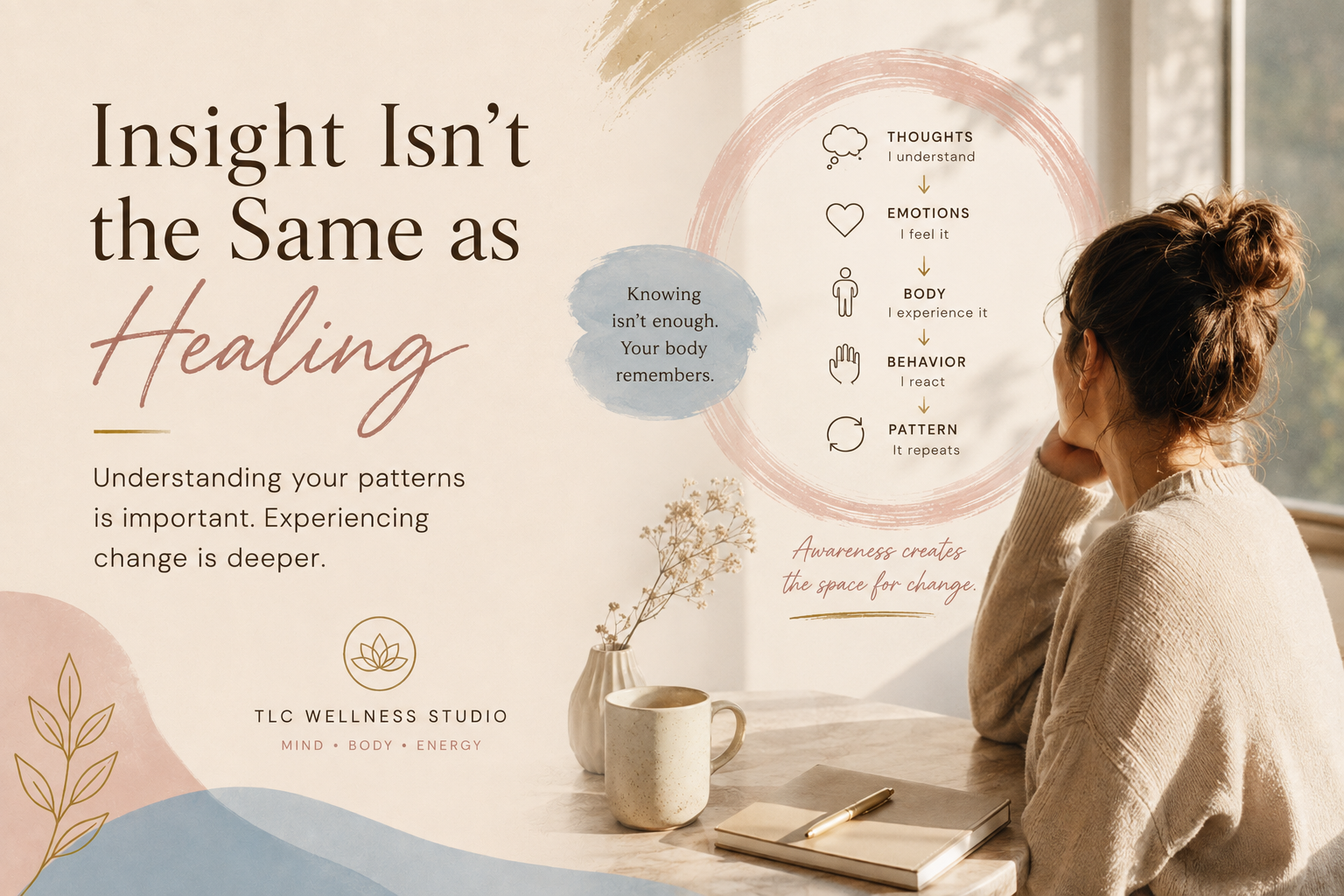
You can understand why you do something and still do it.
You can know where a pattern came from and still find yourself repeating it.
You can explain your anxiety perfectly and still feel anxious.
You can recognize that a relationship isn’t healthy and still struggle to leave.
This can be incredibly frustrating.
Especially when you’ve spent years learning about yourself.
You may eventually wonder:
“If I understand myself so well, why haven’t I changed?”
Because insight and change are not necessarily the same process.
Understanding is valuable
Insight matters.
Understanding your history can help you recognize patterns.
Learning about your emotions can give you language for experiences that once felt confusing.
Recognizing triggers can help you anticipate situations that activate you.
But insight alone doesn’t automatically change every emotional, physiological, or behavioral response.
Psychotherapy research has increasingly examined not only whether therapy works, but how change happens and which mechanisms contribute to meaningful improvement.
That distinction is important.
Knowing something is different from experiencing something differently.
The difference between knowing and responding
Consider someone who knows:
“When someone is upset with me, I immediately assume I’ve done something wrong.”
They may understand exactly where that pattern came from.
They may be able to describe it beautifully.
But when someone becomes upset, their body still reacts.
They still become anxious.
They still feel compelled to fix the situation.
Their intellectual understanding hasn’t necessarily reached the level of automatic response.
This is where deeper therapeutic work can begin.
The body can participate in the pattern
Stress responses involve physiological systems designed to help us adapt to perceived demands or threats.
When stress is prolonged or repeatedly activated, researchers use concepts such as allostatic load to describe cumulative physiological burden across multiple systems.
That doesn’t mean the body is storing every experience like a recording.
It means our experiences can influence patterns of physiological response, attention, emotion, learning, and behavior.
So sometimes the question isn’t simply:
“What do I think about this?”
It may also be:
“What happens in me when this occurs?”
From knowing to noticing
One step toward change is learning to notice the entire sequence.
For example:
Something happens.
↓
Your body reacts.
↓
An emotion appears.
↓
Your mind creates meaning.
↓
You feel an urge to act.
↓
You act.
↓
The pattern reinforces itself.
When you can see the sequence, you have more opportunities to intervene.
Not necessarily by forcing yourself to react differently.
But by becoming aware of where the pattern takes over.
Healing isn’t about erasing your history
We don’t need to pretend that difficult experiences didn’t happen.
And we don’t need to find a perfect explanation for every reaction.
The goal is not to erase your past.
It’s to develop more choice in the present.
Maybe you notice the urge to apologize immediately—but pause.
Maybe you recognize anxiety—but don’t automatically obey it.
Maybe you notice anger—and become curious about what sits underneath it.
Maybe you realize that someone else’s disappointment doesn’t automatically mean you’ve done something wrong.
Those are meaningful changes.
A more useful question
Instead of asking:
“Why am I still doing this when I know better?”
Try:
“What happens between knowing better and being able to respond differently?”
That question opens up much more territory.
It invites us to explore emotion, physiology, behavior, relationships, learned patterns, and the context in which change is occurring.
And that is where therapy and other forms of carefully considered healing work can become much more than simply understanding your story.
A Reflection
Think of one pattern you understand intellectually but still struggle to change.
Then ask:
What happens in my body when the pattern begins?
What emotion appears first?
What do I immediately believe?
What do I feel compelled to do?
You don’t have to change it today.
Start by noticing the sequence.
Continue the Conversation
For more conversations about emotional patterns, mind-body wellness, and whole-person approaches to healing:
Join the TLC Wellness community on Skool:
https://www.skool.com/tlc-wellness-5108
This article is for educational purposes and is not a substitute for individualized mental health care.