By TLC Wellness
There is an important distinction we don’t talk about enough:
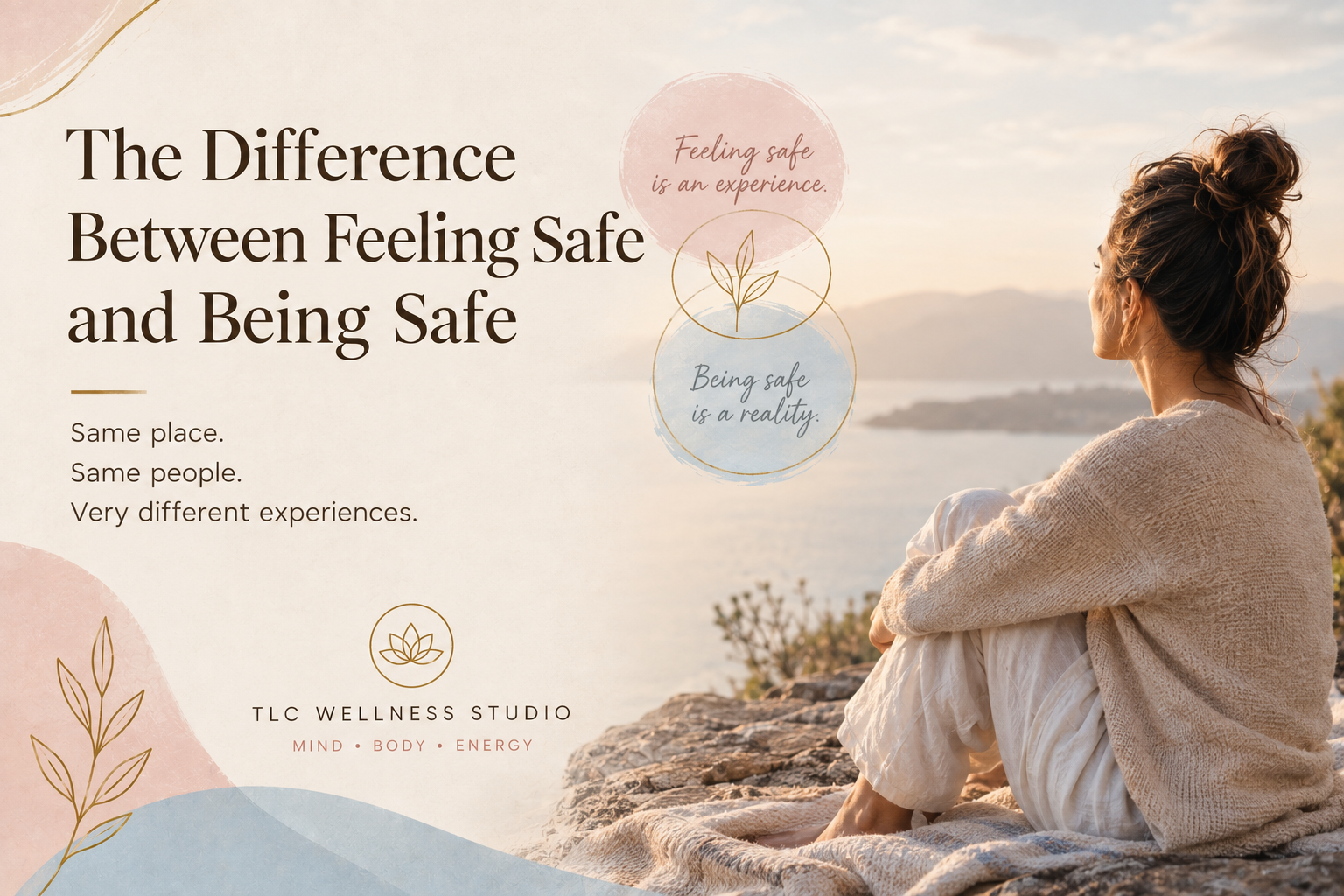
Feeling safe and being safe are not always the same thing.
You can be physically safe and still feel anxious.
You can be in a familiar environment and still feel on edge.
You can be with a kind person and still find yourself waiting for something to go wrong.
And sometimes the opposite is true.
You can feel comfortable in a situation that isn’t actually healthy for you because it is familiar.
This is where the idea of “safety” becomes more complicated.
Safety is more than the absence of danger
Our nervous system is constantly responding to information about our environment.
Stress-related systems help us adapt to demands and potential threats. The body’s response can involve changes in heart rate, breathing, attention, hormones, and behavior.
So when someone says:
“I know I’m safe, but I don’t feel safe.”
They’re describing a real experience.
Their cognitive assessment and their physiological response may not be completely aligned.
Why can familiarity feel like safety?
Our systems learn.
If someone grows accustomed to criticism, unpredictability, emotional distance, or conflict, those experiences can become familiar.
That doesn’t mean they are healthy.
It means familiarity can influence expectations.
This is one reason people sometimes find themselves repeating relationship patterns even when they consciously want something different.
The familiar can feel predictable.
Predictability isn’t necessarily the same as safety.
Feeling unsafe doesn’t automatically mean you’re in danger
This distinction matters too.
A strong physiological response can be real without being an accurate measure of present danger.
Research into trauma-related fear and memory has examined how reminders and contextual cues can activate defensive responses, sometimes producing strong emotional and physiological reactions in response to relatively minor reminders.
So the goal isn’t to dismiss the response.
It’s also not to automatically treat every feeling of danger as proof that danger is present.
We can hold both questions:
What am I feeling?
and
What is actually happening right now?
What does safety feel like?
For some people, safety isn’t an intense feeling of calm.
It may be subtler.
You may notice that you don’t have to monitor everyone else’s mood.
You don’t have to rehearse every conversation.
You don’t feel compelled to explain yourself constantly.
You can make a mistake without expecting catastrophe.
You can say no.
You can rest without feeling guilty.
You can disagree without immediately assuming the relationship is ending.
These experiences can create room for greater flexibility.
Learning to recognize safety
If your system has spent a long time responding to stress, slowing down may initially feel uncomfortable.
That doesn’t necessarily mean you’re doing something wrong.
Sometimes we become so accustomed to vigilance that quiet feels unfamiliar.
Instead of forcing yourself to relax, you can begin with observation.
Ask:
What happens when nothing needs my immediate attention?
Do I allow myself to pause?
Do I trust other people to handle their own emotions?
Can I tolerate uncertainty without immediately trying to control it?
What does my body do when I experience genuine support?
These questions can reveal a great deal.
Safety also includes boundaries
Feeling safe doesn’t mean allowing everything.
In fact, healthy boundaries can be an important part of safety.
Sometimes your body is reacting because something genuinely isn’t right.
A relationship may actually be disrespectful.
A situation may actually be threatening.
A boundary may actually be needed.
This is why we shouldn’t turn nervous-system language into a message that every uncomfortable feeling simply needs to be regulated away.
Sometimes discomfort is information.
Sometimes fear is telling you to pay attention.
The work is learning to distinguish between a present-moment threat and a learned response that has been activated by something familiar.
That distinction takes time.
And sometimes it takes support.
A final reflection
Think about a place, person, or relationship where you feel genuinely at ease.
What is different there?
Do you feel listened to?
Do you have room to disagree?
Can you make mistakes?
Can you be quiet?
Can you ask for what you need?
Can you be yourself without constantly monitoring the other person’s response?
Safety may not always feel dramatic.
Sometimes it feels like not having to perform.
Continue the Conversation
If these questions resonate with you, we’re continuing the conversation inside the TLC Wellness community.
Join us on Skool:
https://www.skool.com/tlc-wellness-5108
This article is for educational purposes and is not a substitute for individualized mental health care.